Wolves
Train DreamsWolves are a recurring nonhuman presence in the Moyea Valley, linking ecological change, local belief, and Robert Grainier’s private life. They first appear as voices answering one another across the burned valley, later become the imagined source of hybrid offspring and supernatural danger, and finally arrive physically at Grainier’s cabin in a pack whose sole remaining figure is the wolf-girl Kate. Their significance lies in this movement between landscape, animal society, rumor, and revelation: Wolves are never merely background wildlife, yet the narrative also preserves their distance and refuses to reduce them completely to symbols of human feeling.
Wolves in the Burned Valley
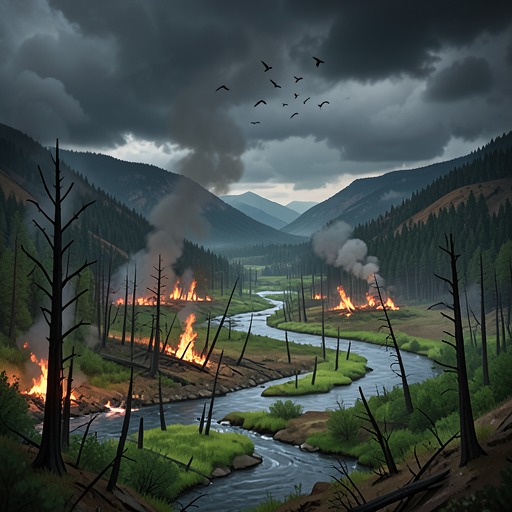
After the 1920 Moyea Valley fire, Grainier believes himself nearly the only creature in the sterile region, but his voice is answered by Wolves on the distant peaks. The calls pass from one group to another until the whole valley seems to sing, while birds cross the burn and pause briefly on their journey. In this first major appearance, Wolves register the survival of life after human devastation. The ruined homesite is not empty; it has become a space in which animal sound replaces the lost human household.
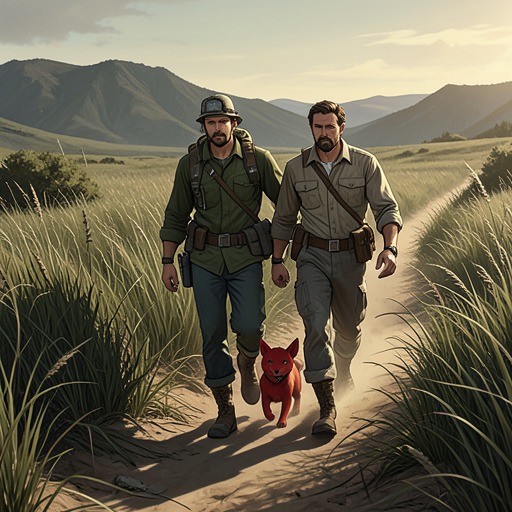
Grainier’s relation to the Wolves is initially auditory and emotional rather than practical. He talks aloud among the ashes while imagining Gladys Grainier’s bonnet and the chocolates associated with Gladys Grainier and Kate Grainier. When a small red-haired female dog joins him, he stops talking to himself because he is ashamed of being overheard by the animal, but the presence of the Wolves gives him another form of speech. Their distant calls become a natural chorus against which his grief can be released.
The post-fire return of animals also makes the Wolves part of a broader ecological succession. When Grainier comes back to the valley with supplies, bears are more numerous than people on the muddy road, orange butterflies rise from bear sign, and huckleberries are returning on the blackened hillsides. Yet this renewal is not a restoration of the old forest. Later, the gorgeous spruce have disappeared, jack pine has become dominant, coyotes have multiplied, rabbits have grown scarce, trout have vanished from stretches of the Moyea River, and the Wolves are heard less often and from farther away. Their retreat is therefore an index of permanent environmental transformation rather than a simple sign of nature’s recovery.
Dog, Wolf, and the Question of Nature
The boundary between Dogs and Wolves becomes unstable when Grainier’s wandering red dog returns to his cabin and whelps four pups that appear distinctly wolfish. Kootenai Bob explains the Kootenai wolf-pack breeding rule: only the chief male mates, and only the selected female comes into heat. On that account, he says, an ordinary dog would not simply produce a litter of Wolves. Grainier proposes that the dog might have encountered a wolf pack at the precise moment she was fertile, and Kootenai Bob allows that the pups might be dog-of-wolf hybrids. He turns the possibility into a teasing but unsettling prophecy, suggesting that Grainier may have started his own pack.
Three pups wander away as soon as the mother weans them. The remaining male is clumsy and fails to answer when the Wolves call at dusk, even though the packs can be heard as far away as the Selkirks on the British Columbia side. Grainier treats the pup’s silence as a failure to grow toward its own nature. He crouches beside it and howls, then stands and howls across the gorge, but the pup remains unresponsive. The scene reverses ordinary domestication: Grainier is the one imitating the wild animal, attempting to awaken an inherited identity that the creature itself does not display.
Although the pup does not learn to howl, Grainier continues howling whenever the Wolves begin their evening calls. The act physically and emotionally relieves the heaviness collecting in his heart, leaving him warm and buoyant after what he imagines as a choir with the British Columbian Wolves. Kootenai Bob condenses the danger of this reversal into the saying, "There’s not a wolf alive that can’t tame a man." The phrase gives the Wolves power not because they conquer Grainier literally, but because they alter his behavior, language, and sense of where his own nature may lie.
Wolves as Rumor and Threat
The Wolves also organize a network of local stories about animals that cross the border between human and nonhuman. Peterson claims that his own dog shot him after returning from a thirteen-day absence, during which it had become nearly wild. He believes the dog had been confabulating with the wolf-girl, and he repeats Kootenai Bob’s warning that the animal should be killed because the girl’s image could be seen in the black of its eyes. In Peterson’s account, Wolves are not only predators; they are a social world capable of drawing domesticated animals away from human loyalty.
The rumor grows through repetition and elaboration. Kootenai Bob is said to have warned that the wolf-girl might call herself into a house, make its inhabitant meat for Wolves, and run along the roads speaking in the victim’s own voice to people he had wronged. These claims transform animal behavior into moral judgment and make the wolf pack an imagined tribunal. The dog’s altered conduct, the supposed wolf-girl, and the fear of hybrid offspring merge into a single story about violated boundaries and punishment.
The sheriff examines the witnesses and finds them frank and sober, judging from their testimony that the creature is female. Even so, the community’s response is driven less by evidence than by accumulated speculation. People fear that she will whelp more wolf-people and monsters, while hostile talk predicts that only fire and blood can purge the valley. The Wolves thus become a screen for racial, religious, and social anxieties: the tales invoke the Kootenai people as supposedly vulnerable to superstition and imagine the wilderness as a source of contamination. The rumors eventually recede when election concerns take over public attention, showing how quickly collective terror can be displaced without being resolved.
The Pack at Grainier’s Cabin
The Wolves’ most powerful appearance occurs after Kootenai Bob’s death beneath the trains. For several nights, the Great Northern train sounds long whistles while moving slowly through the area so that Kootenai people can search the tracks for what remains of their relative. The whistle starts the coyotes, and then the Wolves answer. Grainier’s red dog is somewhere outside as well, and the full-moon chorus becomes the loudest and most pitiable he has ever heard.
The sound expands until it seems to come from hundreds of Wolves and Coyotes, joined perhaps by owls, eagles, and every other voiced creature on the surrounding peaks and ridges. Grainier cannot sleep; he experiences the noise as a pronouncement, possibly an alarm announcing the end of the world. The scene gives the animal voices a scale beyond human explanation. They are not presented as a tidy natural mechanism but as a vast, collective utterance whose meaning exceeds Grainier’s ability to interpret it.
Near midnight, the pack floods into the clearing around his cabin. Shadows and bodies rush past, several brushing against him in the doorway, and their footfalls cross the earth before the entire group disappears. One remains. She is the wolf-girl. Grainier first sees a hurt, panting figure with the delicate structure of a little girl, though her arms and legs are bent. Her whimpering stops as he approaches, and she lies perfectly still, moving only her eyes while animal dread governs her body. Her eyes shine green in the lamplight like a wolf’s, and her face is wolf-like but hairless.
Grainier asks, "Kate?" and recognizes her as Kate Grainier despite the fact that nothing visible proves the identity. The recognition is an act of knowledge rather than deduction. The Wolves have brought to his threshold not an abstract monster but the child he thought had died in the fire. Their pack is therefore both an animal collective and the medium through which a destroyed family returns in transformed form.
Ecological and Narrative Significance
The Wolves mark the limits of human control throughout the narrative. Men attempt to restrain and kill animals, tell stories about them, train them, and interpret their sounds, yet Dogs slip ropes, hybrid pups refuse or obey uncertain natures, and Wolves move across mountains, borders, and human settlements beyond reliable supervision. Even the most intimate human responses—Grainier’s grief, Peterson’s fear, and the community’s moral panic—are shaped by animal movement that no person fully commands.
Their changing distribution also gives the book an ecological timescale. In the immediate aftermath of the fire, Wolves answer one another across the open burn; years later, they gather in overwhelming numbers during the nights following Kootenai Bob’s death; in Grainier’s last years, they have receded, calling from farther away while coyotes increase and the altered valley supports fewer trout. The pattern is neither simple return nor disappearance. It is a record of replacement, displacement, and adaptation in a landscape permanently changed by fire and human settlement.
Finally, Wolves destabilize the distinction between civilization and wilderness. Grainier, who builds a cabin and keeps animals, finds relief by howling with the pack; a supposedly domesticated dog is accused of joining the Wolves; and the wolf-girl’s animal face conceals the family identity Grainier recognizes most surely. The narrative leaves the Wolves partly unknowable, but it makes their unknowability productive. They expose the fragility of human categories—wild and tame, person and creature, memory and fact—while remaining concrete inhabitants of the valley whose presence is measured in tracks, calls, offspring, absences, and the changing distance of their voices.